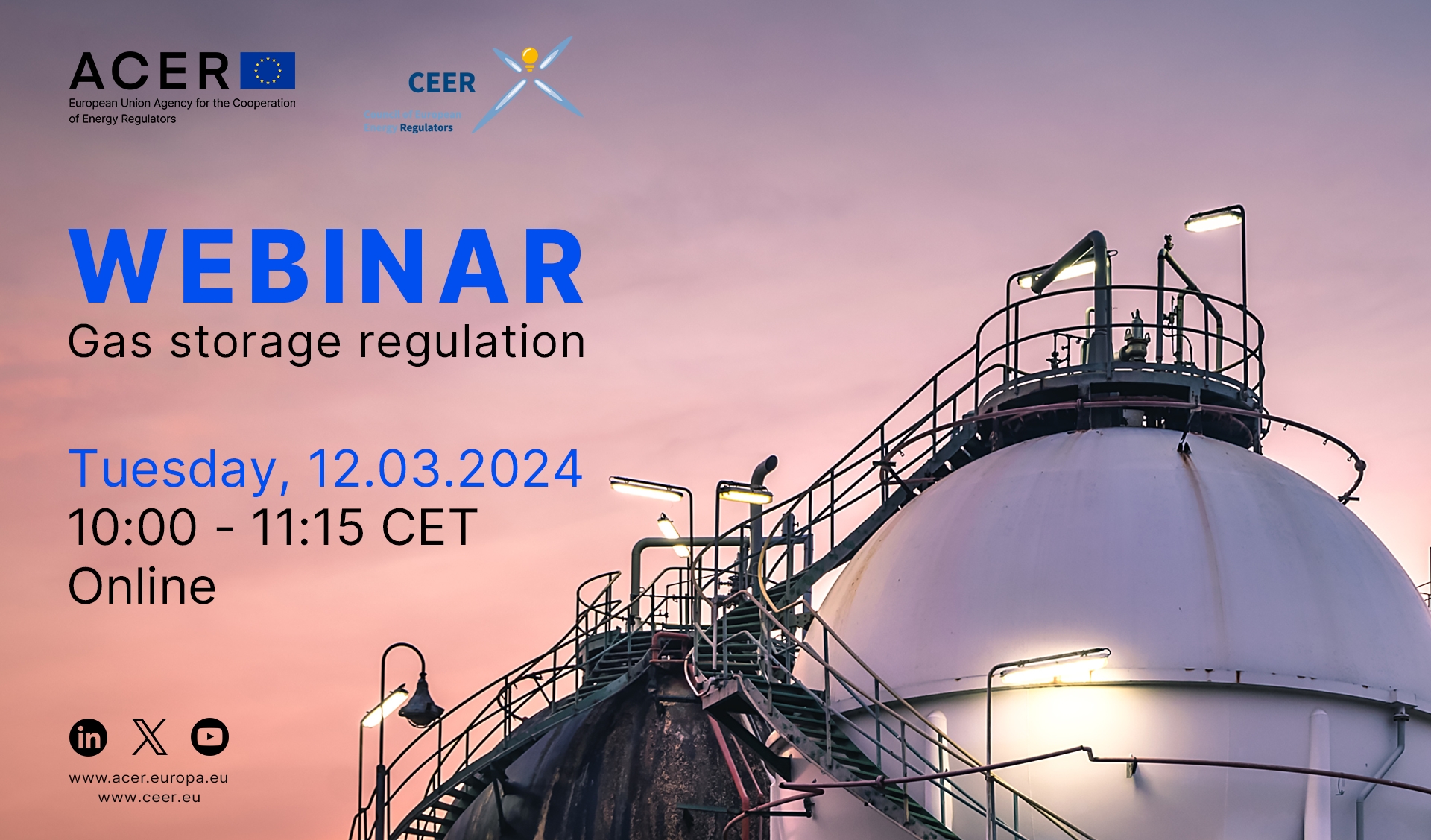
ACER-CEER webinar: gas storage regulation
Online
12/03/2024 10:00
-
11:15
(Europe/Brussels)
ACER’s latest REMIT Quarterly is out
Image

Intro News
This 35th edition provides a summary of the 7th ACER REMIT Forum (5 December, online) on REMIT revision and provides insights into several REMIT topics.
ACER’s latest REMIT Quarterly is out
What is it about?
REMIT (Regulation on Wholesale Energy Market Integrity and Transparency) provides an EU framework for the transparency and integrity of energy markets and deters market participants from manipulating the market. It has an important role in protecting the interests of companies and consumers and ensuring trust in energy markets.
What is the REMIT Quarterly?
The REMIT Quarterly is ACER’s main channel of communication with stakeholders on REMIT-related matters, providing updates on ACER’s REMIT activities.
The 35th edition covers the fourth quarter of 2023 and features:
-
A summary of the 7th REMIT Forum (5 December 2023), which focused on the REMIT revision (trialogue results were published in 2023).
-
An analysis on the hydrogen wholesale market, looking at relevant developments in light of the envisaged expansion of ACER’s market surveillance mandate to hydrogen and renewable gases.
-
The statistics for Registered Reporting Mechanisms’ (RRMs’) contingency reports.
-
An updated overview of the sanction decisions under REMIT for 2023, with 379 cases under review at the end of the fourth quarter.
-
An assessment of the operation and transparency of different categories of market places and ways of trading in 2023, analysing:
-
trends in data reporting;
-
statistics on REMIT and Single Intraday Coupling (‘SIDC’) transaction records; and
-
trading on organised market places.
-
-
Other REMIT updates.
Access the 35th issue of the REMIT Quarterly.
Access all issues of REMIT Quarterly.
ACER publishes its report on the gas transmission tariffs for Portugal
Image

Intro News
The report assesses the reference price methodology proposed by the Portuguese national regulatory authority, ERSE, and provides a recommendation for its motivated decision on the final methodology to be applied.
ACER publishes its report on the gas transmission tariffs for Portugal
What is it about?
ACER publishes today its report on the proposed gas transmission tariffs for Portugal. This report assesses the reference price methodology proposed by the Portuguese national regulatory authority, ERSE, and provides a recommendation for its motivated decision on the final methodology to be applied.
What does ACER say?
ACER concludes that ERSE's proposed reference price methodology (RPM) is appropriate for the Portuguese transmission network but finds one issue to address.
The costs allocated using the RPM also take into account regional networks as opposed to just the Portuguese national transmission network. The use of a single methodology allocating the costs of both networks can potentially result in cross-subsidies between the users of both types of infrastructure (i.e. users of the transmission network may bear the costs of regional networks).
While the proposed RPM partially limits cross-subsidisation between the transmission networks and the regional networks, it does not completely prevent this. ACER recommends that the methodology is adjusted so that the costs of regional networks are not allocated to the transmission network.
What are the next steps?
ERSE should take a motivated decision by 4 May 2024 on the methodology to set the tariffs for the coming regulatory period (from 2024 to 2027).
Access all ACER reports on national tariff consultation documents.
ACER calls for improvements to the new gas transmission tariffs proposed for Poland
Image

ACER calls for improvements to the new gas transmission tariffs proposed for Poland
What is it about?
ACER publishes today its report on the tariff consultation for the Polish transmission network. The report provides recommendations to URE, the Polish National Regulatory Authority (NRA), on the proposed tariff methodology which will be used to set the tariffs for 2025 and 2026. The proposed methodology is based on the results of a consultation carried out by the Polish Transmission System Operator (TSO), which concluded on 19 January 2024.
What does ACER recommend?
-
Justify the proposed discount: the TSO proposed 100% discount at the entry point of the LNG terminal to increase the security of supply of the Polish network. ACER recommends that URE provides further justification on how the discount is set and how it supports this goal.
-
Set a fixed entry-exit split: despite the network code on harmonised transmission tariff structures (NC TAR) prescribing a fixed entry-exit split, the TSO proposes a variable split. ACER recommends setting a fixed entry-exit split to improve the predictability of network tariffs (e.g. network users could better forecast network tariffs).
-
Provide forecasts: ACER recommends that the NRA explains the indicative evolution of tariffs in 2025 and 2026. This information will be useful for network users to understand the proposed methodology and its impact over time.
-
Reconciliation of non-transmission services: ACER recommends reconciling potential under- or over-recoveries for both transmission and non-transmission services, separately. Doing so will enhance the accuracy of cost reflectivity of tariff.
What are the next steps?
By 18 July 2024, URE should adopt a motivated decision on the tariff methodology to be applied to the Polish transmission network. This decision shall also take ACER’s recommendations into account.
Access all ACER reports on national tariff consultation documents.
Regulators request more time to agree on the cross-zonal capacity calculation methodology for the balancing timeframe in the Hansa region
Image

Intro News
NRAs of the Hansa capacity calculation region requested a six-month extension from ACER to agree on the TSOs' proposed cross-zonal capacity calculation methodology for the balancing timeframe
Regulators request more time to agree on the cross-zonal capacity calculation methodology for the balancing timeframe in the Hansa region
What is it about?
On 17 January 2024, the National Regulatory Authorities (NRAs) of the Hansa capacity calculation region requested a six-month extension from ACER to agree on the Transmission System Operators’ (TSOs’) proposed cross-zonal capacity calculation methodology for the balancing timeframe in the Hansa region.
The Hansa region comprises 6 countries: Denmark, Germany, the Netherlands, Norway, Poland, and Sweden.
What is the methodology about?
The cross-zonal capacity calculation methodology for the balancing timeframe describes the rules for each Capacity Calculation Region (CCR) on how to calculate the amount of capacity available for the exchange of balancing energy or for operating the imbalance netting process.
This methodology is relevant for ensuring a balance between the electricity’s generation and consumption and support TSOs as they are ultimately responsible to ensure the stability of the electricity transmission system and to effectively run its operations.
What are the next steps?
ACER intends to act promptly on this request, aiming to reach a decision by mid-March.
Ms Edit Herczog is the new Chair of the ACER Administrative Board
Image

Intro News
ACER welcomes Ms Edit Herczog as the new Chair and Mr Bogdan Marius Chirițoiu as the Vice-Chair of its Administrative Board.
Ms Edit Herczog is the new Chair of the ACER Administrative Board
What is it about?
ACER welcomes Ms Edit Herczog as the new Chair and Mr Bogdan Marius Chirițoiu as the Vice-Chair of its Administrative Board.
Ms Herczog and Mr Chirițoiu were elected by the Administrative Board members on 13 December 2023. Their two-year mandate started on 28 January 2024.
Welcoming Ms Herczog and Mr Chiritoiu, the ACER Director, Christian Zinglersen, expressed his gratitude to the outgoing Chair, Mr Thiollière, for his commitment as he led the Administrative Board including during the recent energy crisis.
Ms Herczog, previously the Vice-Chair under Mr Thiollière’s chairmanship, is a former member of the European Parliament (2004-2014) and the Hungarian national parliament. Currently she is active in the fields of public research, education, and digital infrastructure. Taking up the mantle, Ms Herczog underlined her commitment to advancing ACER's contribution to fostering an integrated European energy market and reaching the Green Deal’s decarbonization targets while securing access to sustainable energy for European citizens and business.
Mr Chirițoiu is Chairman of the Romanian Competition Council, the National Competition Authority in charge with enforcing competition and state aid rules.
Alongside the change in leadership, the membership of the Administrative Board is also changing.
The European Parliament has appointed Mr Paul Rűbig as a new member and Ms Rebecca Harms as an alternate; their mandate started on 21 January 2024.
The Council of the EU appointed three members and three alternates, including Mr Chirițoiu, Mr Dąbrowski, Ms Narodoslawsky, Ms Lunning, Ms Čelić, and Mr Makšijan, who also started on 28 January 2024.
ACER is looking forward to working with the new leadership, members and alternates of the Administrative Board.
More on the Administrative Board
The Administrative Board is ACER’s governing body. It appoints its main bodies, including the Director, adopts the annual work programme and its multi-annual programme. It also plays a central role in establishing the Agency’s budget.
The Administrative Board is composed of 9 Members and 9 Alternates, appointed by the European institutions. 2 members are appointed by the European Commission, 2 by the European Parliament and 5 by the Council of the European Union.
Cyber incident at the EU Agency for Cooperation of Energy Regulators (ACER)
Image

Cyber incident at the EU Agency for Cooperation of Energy Regulators (ACER)
Update: 26 January 2024
- With the security incident of last year, the Agency remained functional.
- The extranet, which was taken offline for immediate remediation actions, was brought back in January.
- Affected third parties were notified of the alternative business continuity arrangements, which were adopted in early January.
- ACER has undertaken mitigation actions in line with recommendations of the Cyber Security Service for the EU institutions, bodies and agencies (CERT-EU).
- REMIT systems remain fully segregated.
- Our forensic investigation is now closed. We are auditing our systems to identify gaps and further protect them.
- The Agency is committed to learning from this experience. To this end, we are undertaking further security enhancements throughout 2024 to further improve our cybersecurity posture. The Agency is conducting a thorough review of our cybersecurity measures, policies, and training protocols in line with our security-first approach.
- Furthermore, the Agency will strengthen its internal cybersecurity risk management, governance and control framework in line with the new Cybersecurity Regulation (which came into effect on 7 January 2024 and which is applicable to all EU institutions, bodies and agencies).
- We have established a dedicated e-mail channel DataSecurity@acer.europa.eu to address any concerns.
More specific guidance for stakeholders who interact regularly with ACER
ACER has received queries from stakeholders on the impact of the cyber incident and requests for guidance. ACER offers the following information:
REMIT/LNG data and use of Virtual Private Network (VPN):
- The Agency has secure systems for sensitive data.
- Based on the evidence to date, the data reported by market participants to the Agency, in line with their obligations under the REMIT Regulation and the LNG market data safeguarded in ACER's REMIT information systems has NOT been impacted.
- Stakeholders should continue to use a secure channel to report their data to the Agency in line with their obligations under the REMIT Regulation and LNG data reporting obligations.
- Stakeholders (and national regulators) that have a Virtual Private Network (VPN) connection with ACER for the exchange of REMIT data should continue to use their VPN. For stakeholders in the process of setting up their VPN connections to ACER, the set up of the VPN connection should continue.
- Sensitive data should not be sent over e-mail to ACER. This has already been our advice and as such it still stands.
E-mails:
- There is no need to stop e-mail communications with ACER.
- For any sensitive information that can only be communicated to ACER via an e-mail (although not recommended), please send it as a password protected zipped file attachment to the e-mail (with very long passwords; passwords are to be shared via other means than email such as SMS or MS Teams message to the intended recipient).
Press contact: Press@acer.europa.eu
Read more:
- Update: 26 January 2024
- Update: 15 December 2023
- Update: 4 December 2023
- Update: 27 November 2023
AB Decisions of 2024
AB Decisions of 2024
AB Decisions of 2024

Legal notice
Legal notice
What is it about?
The information on this site is subject to a disclaimer and a copyright notice.
Disclaimer
The Agency for the Cooperation of Energy Regulators maintains this website to enhance public access to information about its activities and initiatives. Our goal is to keep this information timely and accurate. If errors are brought to our attention, we will try to correct them.
The Agency for the Cooperation of Energy Regulators accepts no responsibility or liability whatsoever with regard to the information on this site. This disclaimer, however, is not intended to limit the liability of the Agency in contravention of any requirements laid down in applicable national law nor to exclude its liability for matters which may not be excluded under that law.
This information is:
• of a general nature only and is not intended to address the specific circumstances of any particular individual or entity;
• not necessarily comprehensive, complete, accurate or up to date;
• sometimes linked to external sites over which the Agency services have no control and for which the Agency assumes no responsibility;
• no professional or legal advice (if you need specific advice, you should always consult a suitably qualified professional).
Please note that it cannot be guaranteed that a document available on-line exactly reproduces an officially adopted text.
It is our goal to minimise disruption caused by technical errors. However some data or information on our site may have been created or structured in files or formats that are not error-free and we cannot guarantee that our service will not be interrupted or otherwise affected by such problems. The Agency accepts no responsibility with regard to such problems incurred as a result of using this site or any linked external sites.
Copyright notice
Unless otherwise stated, the Agency is the owner of copyright and database rights of this website and its contents. Downloading of this Licensed Material other than for personal use is prohibited. The republication, retransmission, reproduction or other use of this Licensed Material is prohibited.
Information and documents made available on the Agency's webpages are public and may be reproduced and/or distributed, totally or in part, irrespective of the means and/or the formats used, for non-commercial and commercial purposes, provided that the Agency is always acknowledged as the source of the material. Such acknowledgement must be included in each copy of the material.
Citations may be made from such material without prior permission, provided the source is always acknowledged. To cite material from the Agency's website, please list it with the URL, and the month and year you accessed it.
Translations of texts or documents published on this website are authorised subject to the following conditions:
1. Due acknowledgement is given at a suitably prominent place, followed by an appropriate disclaimer, both translated into the relevant language:
“Disclaimer:
This is an unofficial translation from the original [specify language] version of [specify document in source language] published by ACER – the European Agency for the Cooperation of Energy Regulators on [date] and available on its website: https://www.acer.europa.eu/
This unofficial translation was neither reviewed nor approved by ACER. The [specify original language] version of the [specify document], as indicated in the link above, represents the only official document and in case of discrepancies or differences between the [specify original language] version and this translation, the [specify original language] version shall prevail. ACER shall not be held liable for any loss or damage incurred thereby and shall not be held otherwise liable for any errors, omissions or inaccuracies in this translation.”
2. Each page of the translation should contain an additional disclaimer highlighting that the document contains an unofficial translation.
3. A copy of the translation is provided to the Agency at least 5 working days prior to publication on the website for a final approval of the format of the document.
Where prior permission must be obtained for the reproduction or use of textual and multimedia information (sound, images, software, etc.), such permission shall cancel the above-mentioned general permission and shall clearly indicate any restrictions on use.
What is an e-service?
An e-service on the Agency website is a service or resource made available on the Internet in order to improve the communication between citizens and businesses on the one hand and the Agency on the other hand.
Three types of e-services are or will be offered by the Agency website:
1. Information services that provide citizens, media, business, administrations and other decision makers with easy and effective access to information, thus increasing transparency and understanding of the policies and activities of the Agency;
2. Interactive communication services that allow better contacts with citizens, business, civil society and public actors thus facilitating policy consultations, and feedback mechanisms, in order to contribute to the shaping of policies, the activities and the services of the Agency;
3. Transaction services that allow access to all basic forms of transactions with the Agency, e.g. procurement, financial operations, recruitment, event enrolment, acquisition or purchase of documents etc.
How do we treat e-mails you send us?
Many web pages on the Agency website have a "Contact" button, which activates your e-mail software and invites you to send your comments to a specific functional mailbox.
When you send such a message, your personal data is collected only to the extent necessary to reply. If the management team of the mailbox is unable to answer your question, it will forward your e-mail to another service. You will be informed, via e-mail, about which service your question has been forwarded to.
If you have any questions about the processing of your e-mail and related personal data, do not hesitate to include them in your message.