ACER finds that contractual congestion in the EU gas networks remains low in 2021

Image
Gas pipelines

ACER finds that contractual congestion in the EU gas networks remains low in 2021

What is it about?

The EU Agency for the Cooperation of Energy Regulators (ACER) publishes today its 9th Report on the Contractual Congestion in the EU gas markets. The report found that contractual congestion in the EU gas transmission networks in 2021 remained low, but that competition for transmission capacity increased in the fourth quarter of the year.

Why contractual congestions should be monitored?

Contractual congestions are relevant as they signal a reduction in market efficiency: while some network users are not able to obtain the transmission capacity product of their choice (and need to rely on congestion-mitigating measures to access the gas market), others who contracted capacity may not use it.

What are the Report’s main findings?

  • In 2021, congestion remained low, as observed in 2020. 18 exit and entry points were congested in the EU gas networks - around 5% of all Interconnection Points (IPs) in the EU - compared to 19 in 2020. Half of the reported congestion in 2021 is due to auction premia (where the market clearing price exceeds the regulated capacity tariff), which occurred in the auctions of yearly, quarterly and monthly capacity products. The other half is caused by the lack of offer of any yearly, quarterly and monthly capacity products.

  • In the fourth quarter of 2021, competition for transmission capacity increased as manifested through the rising number of auctions clearing with a premium. This applied to several products, from quarterly to within-day capacity products. Rising spreads between markets as of September 2021 could have increased competition for cross-border capacity. If the same level of competition persists in 2022, a rise of contractual congestion may be observed.

Without pre-empting the full analysis of capacity auctions during 2022 (which will be covered in the next edition), ACER observes that multiple auctions in the first and second quarters of 2022 have closed with premia.

Moreover, in a dozen of cases, auctions were terminated without any allocation of capacity because the allocation mechanism has not been flexible enough to accommodate the prevailing market conditions (with high and volatile market spreads). As such, the respective auctions had not been cleared before the capacity product would become active.

Has progress been registered?

While the number of congested IP is low, local contractual congestion can be severe and reduce market efficiency. Around 85% of the congested IPs in 2021 were also congested in the past. On the other hand, three of the congested IPs concerned (German domestic IP sides) have disappeared due to the German market merger. Competition for capacity may shift to other points bordering the German market area.

How can congestion be addressed?

Gas Transmission System Operators (TSOs) can apply several congestion management procedures (CMPs) to ensure users can access the network even when they cannot obtain a specific capacity product in the primary capacity auctions. The oversubscription mechanism (where more capacity is marketed than is technically available) remains the most applied CMP in 2021 despite its usage has further decreased. This decrease is partly compensated by a quadruplicated usage of the surrender mechanism (where a network user returns unused capacity to the TSO who can reallocate it to other parties).

More than half of the congested IPs are already covered by the firm day-ahead use-it-or-lose-it mechanism (FDA UIOLI), while the respective National Regulatory Authorities (NRAs) need to take action for the remaining ones, which shall be in line with the European Commission’s rules on contractual congestion.

What are ACER’s recommendations and policy reflections?

  • ACER recommends the European Network of Transmission System Operators for Gas (ENTSOG) and TSOs to continue improving data reliability to ensure the accuracy of information available at the ENTSOG Transparency Platform.

  • ACER welcomes the proposal of the European Commission’s ‘Hydrogen and Decarbonised Gas Market’ Package for revising the CMP guidelines. The proposal addresses several long-standing issues raised by ACER.

Access the 9th Congestion Report and its Technical Annex.

ACER has decided on the methodology for training and certification of staff working for Regional Coordination Centres

Image
Two people cooperating in front of electricity transmission lines

ACER has decided on the methodology for training and certification of staff working for Regional Coordination Centres

What is it about?

The EU Agency for the Cooperation of Energy Regulators (ACER) has reached a decision on the methodology for training and certification of staff working for Regional Coordination Centres (RCCs).

What are the Regional Coordination Centres (RCCs)?

The Regional Coordination Centres (RCCs) are established by the Electricity Regulation and replace the regional security coordinators (RSCs) foreseen by the System Operation Guideline. RCCs cover the tasks carried out by RSCs as well as additional system operation, market related and risk preparedness tasks.

Their tasks include: 

  • supporting the consistency assessment of transmission system operators' defence and restoration plans,

  • carrying out regional outage planning coordination,

  • carrying out post-operation and post-disturbances analysis, and

  • training and certification of staff working for RCCs.

In performing their tasks, RCCs contribute to the achievement of the 2030 and 2050 objectives set by the climate and energy policy frameworks (particularly in relation to fostering security of supply and efficiency, as well as increasing the electrification of the energy sector).

Given the entering into operation of RCCs this year, ACER needs to adopt various methodologies related to their different tasks.

What is the methodology about?

In particular, the Regional Coordination Centre training and certification of staff methodology was adopted by ACER following the assessment of the proposal submitted by the European Network of Transmission System Operators for Electricity (ENTSO-E) to ACER in February 2022.

This methodology prescribes the process to prepare and carry out mandatory training and certification programmes for all RCC Operators, including:

  • explaining the roles and responsibilities of the RCC training coordinator,

  • setting the key aspects to be covered by the RCC training programme, RCC joint training modules and joint training programmes, and

  • defining the organisation, structure and requirements for the certification of staff.

How did ACER contribute?

ACER reviewed ENTSO-E’s proposal and ensured the methodology is in line with the objectives of the Electricity Regulation and fulfils its legal obligations.

Access ACER’s Decision 07-2022.

ACER to decide on the Swedish TSO’s request for derogation from 70% requirement

Image
Transmission line in Sweden
Intro News
The Swedish regulatory authority (Ei) received an application from the Swedish TSO Svenska kraftnät (SvK) for a derogation from the minimum capacity available for cross-zonal trade (‘70% requirement’) for multiple electricity interconnections for 2022.

ACER to decide on the Swedish TSO’s request for derogation from 70% requirement

What is it about?

The Swedish regulatory authority (Ei) received an application from the Swedish Transmission System Operator (TSO) Svenska kraftnät (SvK) for a derogation from the minimum capacity available for cross-zonal trade (‘70% requirement’) for multiple electricity interconnections for the year 2022.

Ei decided to reject the part of SvK's derogation request concerning the interconnectors between the bidding zones: Denmark 2 – Sweden 4, Germany & Luxembourg – Sweden 4, Poland – Sweden 4 and Lithuania - Sweden 4, as well as for the internal Swedish bidding zone borders SE3-SE4 and SE2-SE3.

Ei decided that SvK should be granted a derogation for the interconnectors between the bidding zones Finland – Sweden 3 (FI - SE3) and Denmark 1 – Sweden 3 (DK1 - SE3) bidding zones for the year 2022.

The Finnish Energy Regulatory Authority (EV) and the Danish Energy Regulatory Authority (DUR) opposed granting the derogations to SvK.

The question of derogation must therefore, in accordance with Article 16 (9) of the Electricity Market Regulation, be submitted to ACER.

What are the next steps?

ACER invites interested stakeholders to submit their views by 30 June 2022 to the email: ACER-ELE-2022-010(at)acer.europa.eu.

Link to: SvK derogation request (EN)

Link to: Ei decision (SE)

Link to: Ei decision (unofficial English translation)

ACER expects to reach its decision by 27 October 2022.

What role has ACER?

ACER’s decision will provide clarity on the application of the Electricity Regulation with regard to the minimum capacity available for cross-zonal trade based on its Article 16(8) and possible derogations pursuant to its Article 16(9). ACER’s decision will impact the effectiveness and integration of the Nordic electricity markets.

ACER - ENTSOG workshop on the FUNC issue: how to ensure greater flexibility to book firm capacity at interconnection points

ACER - ENTSOG workshop on the FUNC issue: how to ensure greater flexibility to book firm capacity at interconnection points

Online
Microsoft Teams
27/06/2022 09:00 - 12:30 (Europe/Brussels)
View of gas pipelines

ACER consults on the implementation frameworks for the European balancing platforms

Image
Electricity transmission lines
Intro News
ACER launches today a public consultation on the TSOs’ proposals amending the implementation frameworks for the European balancing platforms for the automatic and manual frequency restoration reserve (aFRR, mFRR) and the imbalance netting.

ACER consults on the implementation frameworks for the European balancing platforms

What is it about?

The EU Agency for the Cooperation of Energy Regulators (ACER) launches today a public consultation on the TSOs’ proposals amending the implementation frameworks for the European balancing platforms for the automatic and manual frequency restoration reserve (aFRR, mFRR) and the imbalance netting.

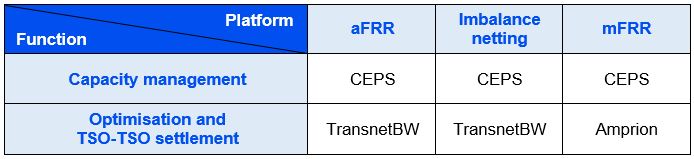
The aim of this consultation is to collect stakeholders’ views on the key areas of the amendments proposed by TSOs; in particular the designation of entities performing the relevant functions of the European balancing platforms and the changes to the technical specifications of the products for the mFRR platform.

All interested parties are invited to share their views by 12 June 2022, 23:59 hrs (CET).

Access the Public Consultation and share your views!

ACER will also hold a public workshop on 31 May 2022, from 14.00 to 15.00 CET, to present the implementation frameworks and its proposals for amending them, as well as to gather further views from stakeholders. Register now!

ACER calls Ukrainian graduates to apply to its traineeship positions: three places available

Image
Ukrainian Flag
Intro News
ACER is offering three Ukrainian graduates the possibility to join its Traineeship Programme, with the aim of supporting their professional development.

ACER calls Ukrainian graduates to apply to its traineeship positions: three places available

What is it about?

The EU Agency for the Cooperation of Energy Regulators (ACER) is offering three Ukrainian graduates the possibility to join its Traineeship Programme, with the aim of supporting their professional development.

ACER’s Traineeship Programme allows university graduates to develop professionally through an enriching experience in Ljubljana, Slovenia.

Normally only open to European Economic Area (EEA) graduates, ACER has opened up three traineeship positions for Ukrainian nationals.

What does the traineeship look like?

Trainees have the opportunity to work in one of ACER’s work areas such as:

  • HR

  • Communications

  • Market Analysis

  • Gas Security of Supply

  • System Operation and Grid Connection

  • Regulation on Electricity Market Integrity and Transparency (REMIT) Policy

Trainees will be recruited for 6 months, which can be extended for an additional 6 months (one year maximum). The start of the traineeship period is subject to the selected candidate’s availability, as well as to the needs of the relevant ACER department.

The traineeship will take place at ACER premises, in Ljubljana, Slovenia. However,  in line with the current rules on teleworking, trainees and other staff are allowed to telework up to a maximum of 60% of their working time.

Trainees not receiving a salary, scholarship or other form of financial support are provided with a monthly grant of 1,265.36.

Trainees can also be awarded some additional contributions, as specified below.

Reimbursement of travel costs

Those whose place of recruitment is further than 200 km from Ljubljana receive the reimbursement of travel expenses incurred at arrival and departure.

The reimbursement of travel costs for trainees who have their residence outside the territories of the European Union, Norway, Iceland, or Liechtenstein will be calculated based on the geographical distance between Ljubljana and Brussels.

Reimbursement of public transport costs

Costs of public transport (within Ljubljana) used to reach the office are covered at the end of each month.

Coverage of insurance sickness scheme

In exceptional circumstances, ACER will cover the costs of a sickness insurance scheme for the trainee.

Am I eligible?

You are eligible to apply to join ACER’s Traineeship Programme if, by the start of the traineeship period:

  • You have B2 language skills in English.

  • You have completed your university studies for a duration of 3 years or more.

  • You have not been engaged for more than 6 weeks in any kind of employment or traineeship within a European Institution, Agency, or Body. Please refer to Annex I. A of the Rules for the complete list of these organisations.

How can I apply?

You can apply by sending the completed Application Form to the mailbox hr-info(at)acer.europa.eu including in the subject line “TRAINEESHIP UA”.

Please clearly indicate in the form the areas of interest you are applying for. You can do so by choosing 2 profiles, in order of preference, from the following ones:

  • Press and Communications

  • Human Resources

  • IT

  • Policy

  • Market Analysis 

  • Data Analysis

  • Gas Security of Supply 

  • System Operation and Grid Connection 

  • Regulation on Electricity Market Integrity and Transparency (REMIT) Policy

Do not forget to include a copy of your diploma or other official documents from your university proving the completion of your studies.

What are the steps in the selection process?

1. Candidates can apply by sending an e-mail to hr-info(at)acer.europa.eu containing the following attachments:

- Application form (where 2 profiles of interest are indicated in order of preference);

- Copi(es) of their diploma(s).

Candidates can update or withdraw their applications at any time until the closure of the Call. 

2. Applications are screened against the eligibility criteria defined in the Traineeship Call. All applications will be retained for the entire duration of the open call.

3. Eligible candidates will be screened by ACER's departments, considering the candidates' preferences indicated in the application and their competencies.

4. Shortlisted candidates will be contacted, in line with the order of preference emerging during the screening conducted by ACER’s departments. Prior to the final selection decision, candidates may be requested to undergo a further assessment (e.g. via phone/video-call) to evaluate their suitability for the role and discuss mutual expectations. 

5. Successful candidates will receive a Traineeship offer, stating the starting date, the Department in which they will be placed, and the duration of the traineeship.

6. After the offer letter is signed, candidates will be asked to submit a list of relevant documents before the start date.

7. On the first day of their traineeship period and prior to the submission of all required documents, candidates sign the Traineeship Agreement and the relevant annexes.

Where can I find out more about it?

Learn more about the traineeship conditions, the application and selection procedure by consulting:

If you have any questions regarding the new opportunities offered within ACER Traineeship Programme, please contact us at HR-info(at)acer.europa.eu with the following subject line: TRAINEESHIP UA.

Gas tariffs reports: ACER recommends to the Austrian national regulatory authority to further justify the application of the proposed commodity tariffs

Image
Gas pipeline
Intro News
ACER publishes today its second report on the implementation of the European Union Network Code on Harmonised Transmission Tariff Structures for Gas (NC TAR) for the Austrian transmission system.

Gas tariffs reports: ACER recommends to the Austrian national regulatory authority to further justify the application of the proposed commodity tariffs

What is it about?

The EU Agency for the Cooperation of Energy Regulators (ACER) publishes today its second report on the implementation of the European Union Network Code on Harmonised Transmission Tariff Structures for Gas (NC TAR) for the Austrian transmission system.

The report focuses on the introduction of a commodity tariff, which aims at allocating the costs resulting from the recent increase in energy prices taking place in 2021-22 and forecasted for 2023-24. Transmission system operators’ (TSOs) networks require energy to run compressor stations, and the prices of both electricity and gas have increased, compared to the initial estimates made by the national regulatory authority (NRA) in 2020. As a consequence, the Austrian NRA, E-Control, is consulting on the possibility to introduce a commodity charge by 1 June 2022.

What are ACER’s recommendations?

ACER recommends to E-Control to further justify why the proposed commodity tariffs should be applied before the end of the on-going tariff period, which concludes in 2024. Such changes should take place only exceptionally.

In particular, the NRA should:

  • provide additional information on how the increases in energy prices affect TSOs’ capacity to continue operating the network;

  • further justify the entry into force date of the proposed commodity tariffs based on the TSOs’ capacity to continue operating the network;

  • increase the transparency of TSOs’ tenders for purchasing energy, and ensure that these procedures have taken place in a transparent, competitive and non-discriminatory manner.

ACER further notes that, according to the NC TAR, the same flow-based charge should be set at all entry and/or at all exit points. The proposed flow-based charge is not applied at entry points from storage.

Finally, ACER recommends to the NRA to publish the decisions on the TSOs’ allowed revenue, including the initial decision applicable to the current tariff period and the recently adopted amendments to allocate the increase in energy prices. These decisions contain key information for the calculation of the proposed flow-based charge.

E-Control shall adopt a motivated decision on the application of the proposed commodity tariffs by 14 July 2022, although its publication will most likely happen earlier, given the urgency.

Read more on the report.

Access all ACER reports on national tariff consultation documents.

French energy regulator (CRE) fines EDF with the first sanction for insider trading under REMIT, and EDF Trading Limited (EDFT) for market manipulation

Image
acer image
Intro News
On 03 May 2022, the French energy regulatory authority (CRE) published two sanction decisions adopted by its Dispute Settlement and Sanctions Committee (CoRDiS).

French energy regulator (CRE) fines EDF with the first sanction for insider trading under REMIT, and EDF Trading Limited (EDFT) for market manipulation

What is it about?

On 03 May 2022, the French energy regulatory authority (CRE) published two sanction decisions adopted by its Dispute Settlement and Sanctions Committee (CoRDiS) imposing fines of:

  • EUR 500,000 on Electricité de France SA (EDF), for breaching the obligation to disclose inside information under Article 4 of the EU Regulation on Wholesale Energy Market Integrity and Transparency (REMIT) and the prohibition of insider trading under Article 3,

  • EUR 50,000 on EDF Trading Limited (EDFT), for manipulating the French wholesale electricity market in breach of Article 5 of REMIT.

CoRDiS found that in October 2016, in a context of high electricity prices and stressed markets (due to the unavailability of several EDF nuclear reactors), EDF failed to publicly disclose inside information in an effective and timely manner. The information related to the request from the French Nuclear Safety Agency for additional controls over five nuclear reactors, which would lead to their temporary unavailability.

Furthermore, EDF used this inside information to acquire two related wholesale energy products via its trading subsidiary EDFT, thus breaching the prohibition of insider trading.

CoRDiS further assessed an operational mistake that EDFT had acknowledged, which led to excessive purchases on the French day-ahead electricity market and contributed to the price spikes observed on 7 and 8 November 2016. CoRDiS concluded that EDFT’s erroneous orders likely gave false or misleading signals as to the supply and demand on the spot electricity market.

Access CoRDiS’ decisions (in French).

Both sanctions decisions can be subject to an appeal to the French Conseil d’Etat.

What’s the role of ACER?

In accordance with its European wholesale energy market monitoring duties to detect and prevent trading based on inside information and market manipulation, ACER contributed by analysing EDF’s behaviours and providing its preliminary assessment to CRE, stating its reasonable grounds to suspect insider trading by this market participant.

In 2021, ACER updated its Guidance on REMIT (6th Edition) to anticipate upcoming decisions from National Regulatory Authorities (NRAs) on insider trading and on erroneous orders giving false or misleading signals. The updated Guidance included a specific chapter on the prohibition of insider trading (Chapter 5) and provided additional examples of market manipulation (Chapter 6).

ACER welcomes this first decision against insider trading under REMIT, as well as sanctioning market manipulation resulting from erroneous orders. ACER underlines that unintentional behaviours can also possibly disrupt the wholesale energy markets and be subject to market manipulation prohibited by REMIT.